
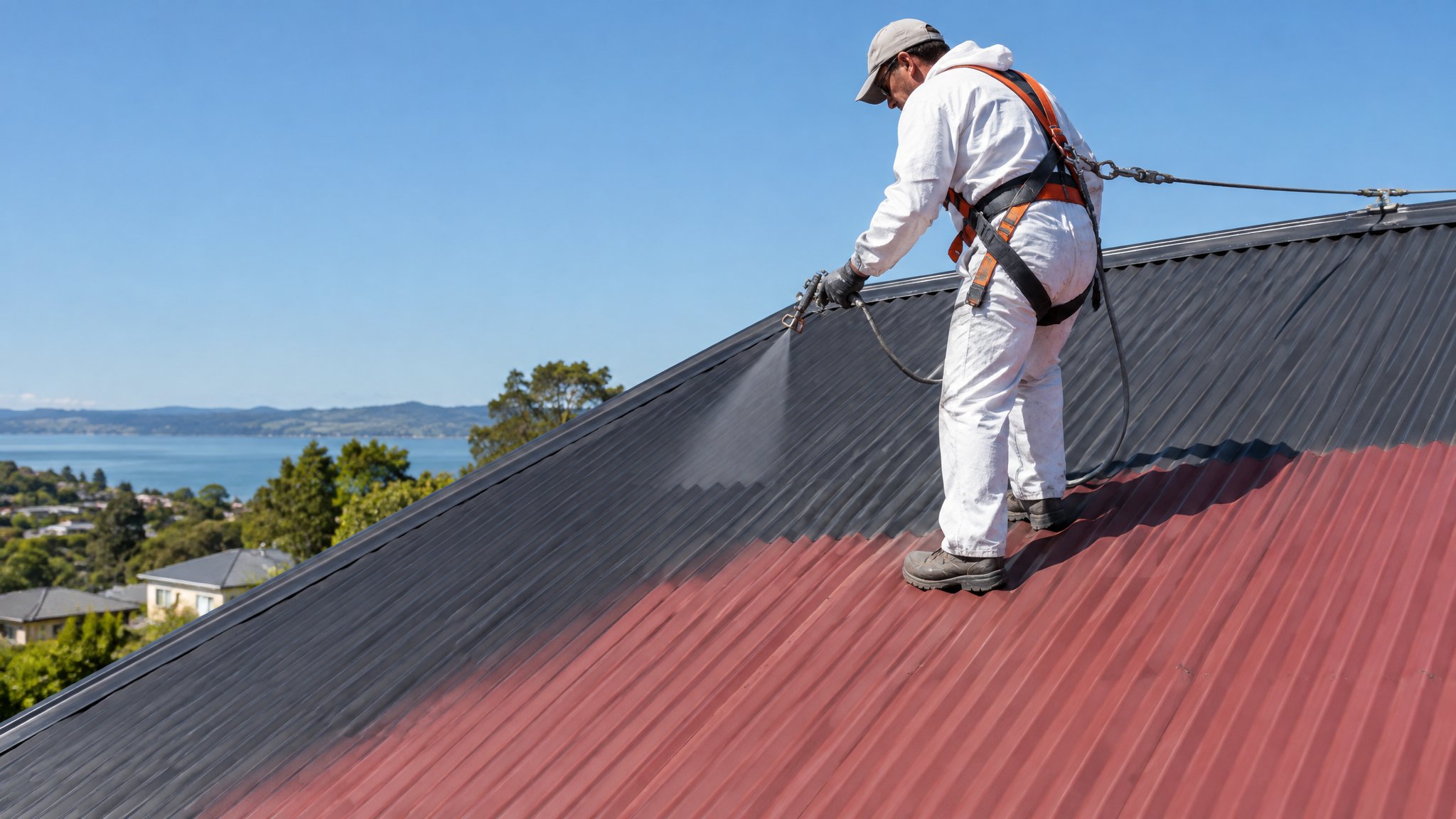
If your roof paint leaves a dusty residue on your hand, that’s chalking. It’s common on painted metal roofs and tiled roofs around Auckland, especially where there’s strong sun, coastal air, and years of weather exposure.
Chalking does not always mean the roof has failed completely, but it is a sign the coating is breaking down. The good news is that in some cases you can clean it up yourself and slow the damage down, provided the roof is still sound.
Why roof paint chalks
Chalking happens when the paint binder starts to break down and releases fine pigment particles onto the surface. In plain terms, the paint loses its grip and turns dusty. On Auckland roofs, UV exposure is usually the biggest culprit, followed by moisture, salt air, and poor surface preparation from the original paint job.
It can also happen faster if the roof was coated with the wrong product, applied too thinly, or painted over dirt, oxidation, moss, or old failing paint. On older homes, years of heat and cooling cycles can make the coating brittle and weak.
- strong UV and heat
- salt air and coastal exposure
- ageing paint film breaking down
- mould, moss, or grime trapping moisture
- poor prep before the last paint job
How to tell if it is chalking or a bigger problem
A chalky roof often looks faded and dull, and when you rub it with your hand you’ll get a powdery residue. If the roof is otherwise intact, with no major rust, bubbling, or peeling, you may be able to clean it and recoat sections yourself later.
If you see flaking paint, rust spots, soft timber, cracked sealant, or leaks, the problem is bigger than chalking. In that case, cleaning alone will not fix the roof for long. You need to deal with the failed coating and any substrate damage first.
- powder comes off on your hand
- surface looks faded rather than peeling
- no widespread rust or lifting paint
- check flashings, valleys, and fixings for damage
A DIY fix for lightly chalked roof paint
If the roof is safe to access and the chalking is only light to moderate, you can improve it yourself by cleaning the surface properly. Start by removing loose debris, moss, and leaf litter. Then wash the roof with a suitable roof cleaner and scrub away the chalky residue with a soft brush or low-pressure wash. Be careful not to force water under laps, flashings, or tiles.
Once clean, let the roof dry fully. After that, inspect for any bare metal, rust, failed sealant, or peeling paint. Spot-prime any exposed areas with the correct primer for the roof material, then apply a compatible roof coating if the manufacturer’s system allows it. Never paint over a dusty surface, because the new coat will not bond properly.
DIY works best when the roof has good overall adhesion and only needs surface restoration. If the chalking is heavy, the coating is brittle, or the roof has already started to peel, a repaint system may be needed rather than a touch-up.
- work only in safe weather and use proper fall protection
- use a gentle clean rather than aggressive water blasting
- remove all chalk, mould, and loose paint before recoating
- match primer and topcoat to the roof material
When to call Steve
If you’re not sure whether the roof is merely chalky or actually failing, it’s worth getting advice before you spend time and money on the wrong fix. Roofs can look simple from the ground, but the real issue often shows up around flashings, overlaps, fixings, and hidden rust. Steve is a Kiwi and a trade-qualified painter, and he can assess whether your roof needs a clean, a spot repair, or a full repaint system that will last better in Auckland conditions.
If you’d like help with roof paint chalking, Steve can also advise on safe prep, the right products, and whether DIY is sensible for your particular roof.
Frequently Asked Questions
Can I paint over chalky roof paint?
Not properly. You need to remove the chalk first, otherwise the new paint may fail early. A thorough clean and the correct primer are usually essential.
Does chalking mean my roof needs repainting?
Not always. Light chalking can sometimes be cleaned and recoated. Heavy chalking, peeling, rust, or leaks usually means the roof needs more than a simple touch-up.
Is roof chalking common in Auckland?
Yes. Strong UV, salt air, and changeable weather can all speed up roof coating breakdown on Auckland homes, especially older roofs.
Need a hand with your project?
Happy to tackle some of it yourself? Great — but for anything you’d rather leave to a professional, Steve Lunjevich is a Kiwi and a trade-qualified painter with 20+ years’ experience. Call or email for honest advice or a free, no-obligation quote.